01 · Profile
What I do
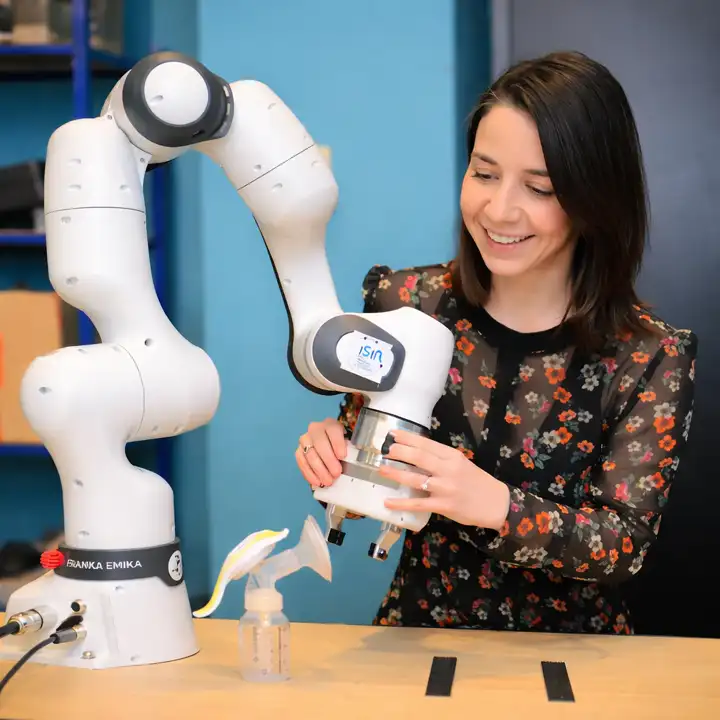
I lead software products for complex, regulated systems: medical devices and assistive robots that have to work for clinicians, patients and operators, not only in the lab.
I am a mechatronics engineer with a PhD in control and robotics, and I have spent twelve years building robots hands-on in research labs, start-ups, a scale-up and an international group. In each of those places I ended up shaping the product as much as the code: what to build, for whom, and how it would really be used. Product ownership in medtech is where that path naturally led.
- PhDin control and robotics (2018), after engineering degrees in Colombia and France
- 7engineers led at Niryo, through the Ned2 launch at CES 2022
- 15+robots worked on hands-on across my career
- 3languages: Spanish native, French bilingual, English professional
One path, many kinds of robotics
- 2014–2018 · Research
- PhD at CEA with Université de Toulouse III, on robots that learn to assist people by demonstration.
- 2018–2019 · Logistics
- Technical lead at Movu Robotics for the first 15 mobile robots deployed in production.
- 2019–2021 · Social robots
- R&D engineer at SoftBank Robotics, on interaction and perception for humanoid robots.
- 2021–2022 · Cobots
- Technical lead at Niryo, with a 7-person software team and the Ned2 roadmap.
- 2022–2024 · SaaS
- Advisor and co-founder on software products, including Banana Army and Rumble Studio, now spOken.
- 2024–2026 · Assistive
- R&D engineer at ISIR, CNRS, where I built Bloom.
- 2026 · Medtech
- Senior Product Owner Software at Echosens.
How I work
Concretely, my work has covered product framing and roadmaps, specifications, real-time control laws, robot-agnostic software architectures, teleoperation and supervision interfaces, and validation on real platforms rather than only in isolated prototypes.
Across factories, warehouses, social robots and assistive arms I keep returning to one question: how can a complex system become both technically strong and genuinely useful for the people who interact with it?
I translate between researchers, engineers, users, clinicians, product stakeholders, partners and clients, and I see that translation as part of the product work, not something separate from it. The Extender consortium case study shows it in practice.
User-centered by default
Development is not only a technical exercise. It means understanding real situations, real constraints and the people who will live with the result.
- Co-design
- User workshops, co-design sessions and field constraints feed directly into technical decisions.
- Framing
- Product framing, use-case definition and specification work for software and robotics projects.
- Interfaces
- UX review and interface thinking for HMI, teleoperation and web-based tools.
- Agency
- Systems that support human agency rather than forcing rigid usage patterns.
- Training
- Google UX Design foundations course, on top of years of practice.